
The difference between standard and luxury rides comes down to four things: the vehicle, how the driver is vetted, how the trip is insured, and how the price is set. A standard app ride uses a personal car and live pricing. A licensed Detroit black car service uses a commercial fleet, a quoted price, and a professional chauffeur.
Key Takeaways
- Four tiers, not two: standard app rides, premium app tiers, taxis, and licensed black car or chauffeur service all sit on different rungs.
- Same legal floor for app tiers: in Michigan, a premium app driver is usually vetted under the same state rules as a standard app driver.
- Insurance follows the license: app rides carry $1 million in coverage only while a passenger is in the car, according to Michigan LARA.
- Pricing models differ: taxis run a meter, app tiers move with demand, and black car companies usually quote before you book.
- Ask for proof: any company selling a luxury ride should be able to show you its state carrier license.
What Separates a Standard Ride From a Luxury Ride?
A standard ride is an on demand trip in a driver’s own car, priced by the app in real time. A luxury ride is a pre booked trip in a commercial sedan or SUV, driven by a professional chauffeur, with a price agreed ahead of time. The gap shows up most in vetting, insurance, and who answers when plans change.
Most people think of this as a two way choice. It isn’t. Between a basic app ride and a true chauffeur there are premium app tiers and taxis, and each one is built differently. If you’d rather talk it through for a specific trip, call us at (586) 358-0999, any hour.
We wrote a separate piece on chauffeur versus standard service that covers comfort and occasions. This one goes under the hood. We’ll look at what Michigan law actually requires at each tier, because that’s the part a shiny car can hide.
The Four Ride Tiers Side by Side
Here’s how the four options compare on the points that matter most. Michigan’s Department of Licensing and Regulatory Affairs (LARA) handles state licensing for carriers that move 8 or fewer passengers, including app companies, taxicab carriers, and limousine carriers.
| Factor | Standard app ride | Premium app tier | Taxi | Licensed black car or chauffeur |
|---|---|---|---|---|
| Vehicle | Driver’s personal car | Newer, larger personal car or SUV | Company cab | Commercial luxury sedan, SUV, or van |
| Who licenses it | LARA, as a network company | LARA, as a network company | LARA, as a taxicab carrier | LARA as a limousine carrier (1 to 8 seats), MDOT for 9 or more |
| Driver vetting | State minimum, checked yearly | Same state minimum, plus platform rules | Carrier and state rules | State rules, plus the company’s own hiring and training |
| Insurance | $1 million during a trip, lower limits while waiting | Same as standard in most cases | Carrier insurance under state law | Commercial policy filed with the state |
| Pricing model | Dynamic, changes with demand | Dynamic, higher base | Meter | Quoted trip price or hourly rate |
| How you book | On demand | On demand | Hail, stand, or dispatch | Pre booked, often days ahead |
| DTW pickup | Rideshare staging area | Rideshare staging area | Ground Transportation Center | Arranged with the chauffeur |
Notice the two app columns. The car gets nicer when you move up a tier, but the legal framework often stays the same. That’s the single biggest thing people miss when they pay more for a premium app ride.
Driver Vetting: What Michigan Actually Requires
The state sets a floor for app drivers, and it’s worth knowing where that floor sits. Under Michigan’s TNC driver rules, a driver can’t be under 19 years old. They’re disqualified for more than four moving violations, or one major violation, in the three years before they apply.
Certain felony convictions in the five years before applying also rule a driver out, and so does a listing on the national sex offender registry. The company has to repeat the criminal background check and pull driving records every year. That’s a real standard, and it’s fair to say most app drivers are decent people doing honest work.
Where the tiers split
A premium app driver usually passes the same state check as a standard one. What changes is the car the platform accepts, and sometimes a rating threshold. The app still matches you with whoever is closest. You don’t choose the person, and you won’t know who’s coming until the match is made.
A chauffeur company hires its own people. Good ones interview drivers, check references, train them on routes and client handling, and keep the same faces on repeat accounts. The law doesn’t require most of that, which is exactly why you should ask about it. Our advice is simple: ask how drivers are screened and whether you can request the same chauffeur again.
Insurance and Licensing, the Part Nobody Checks
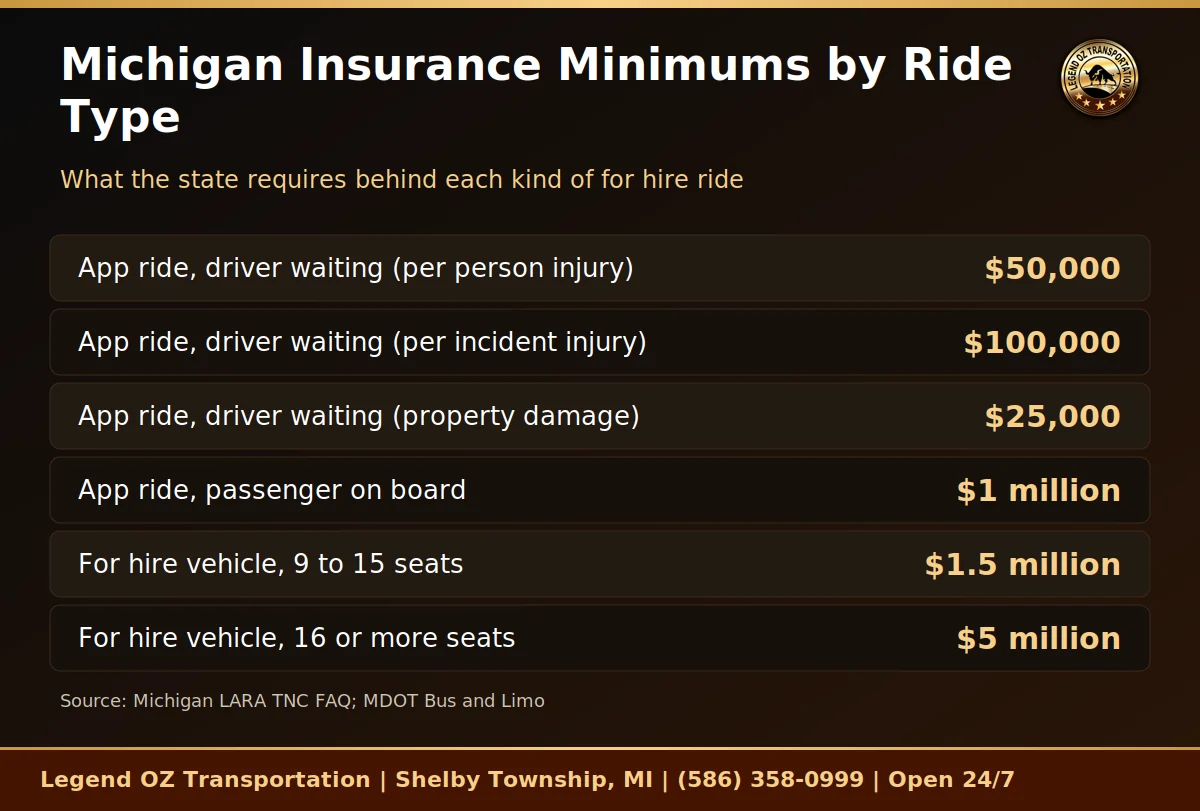
App rides are covered in layers. The same LARA guidance says that while a driver is logged in and waiting, the minimum is $50,000 per person and $100,000 per incident for injury, plus $25,000 for property damage. Once you’re in the car, coverage rises to a $1 million combined single limit.
A limousine carrier works differently. To get licensed, it must file a certificate of insurance with LARA, and the state says a regular Michigan no fault policy doesn’t meet that requirement. It also needs a physical business location. Taxicab carriers are licensed under the same state act, and every one of these licenses renews on August 31 each year.
Bigger vehicles move to a different regulator. MDOT bus and limo rules apply to for hire vehicles carrying 9 or more passengers. For 9 to 15 seats, the minimum is a $1.5 million combined single limit. For 16 or more, it’s $5 million, and those vehicles need annual safety inspections.
Signs you’re booking a properly licensed luxury ride
- The company gives you its business name and can point you to its state carrier license.
- It has a real business address, not just a phone number and a logo.
- You get a written confirmation with the pickup time, vehicle type, and price or hourly rate.
- The vehicle is a commercial fleet car, clean inside and out, with no personal clutter.
- For a group of 9 or more, the operator mentions MDOT authority without you having to ask.
- Someone answers the phone at odd hours if your flight or plans change.
How Each Tier Prices a Trip
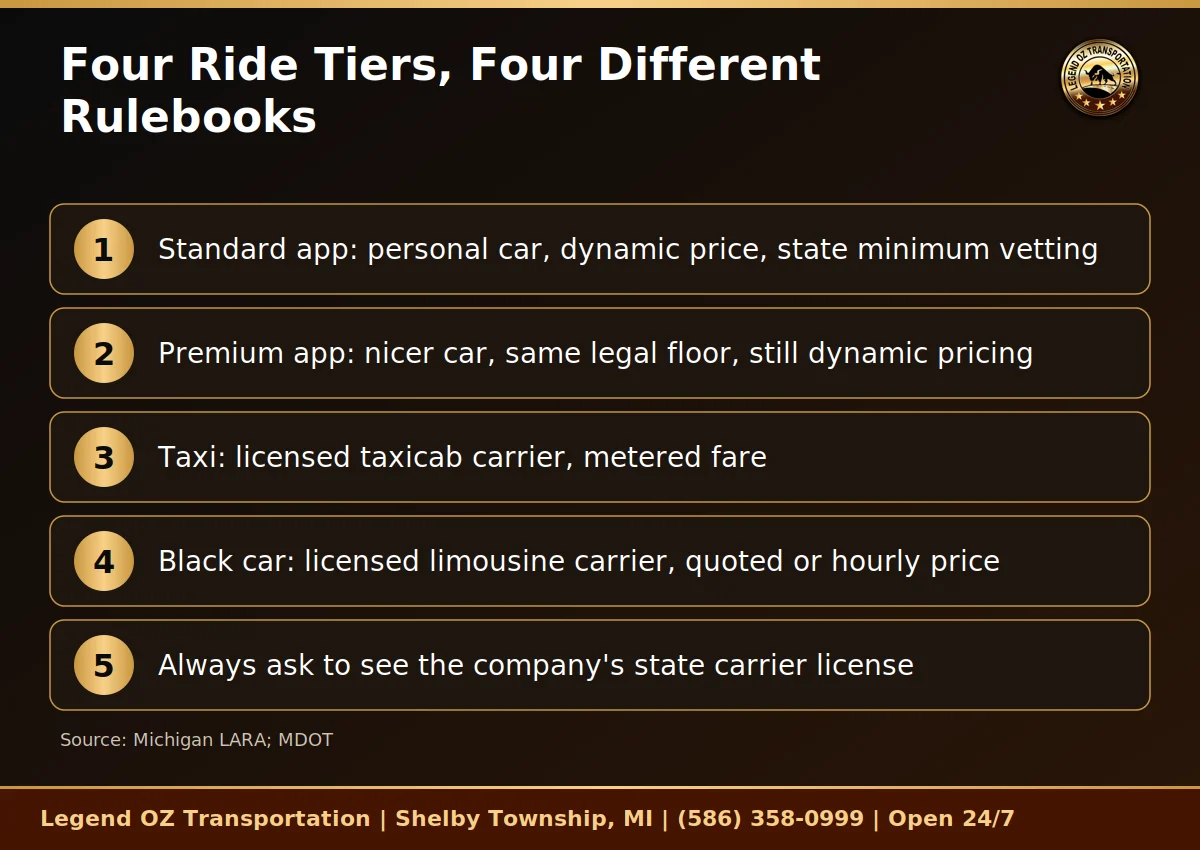
Pricing is where standard and luxury rides feel most different day to day. A taxi runs a meter, so traffic and waiting time add up as you go. A standard app ride shows a price up front, but that number moves with demand, so the same trip can cost more at rush hour or after a big event downtown.
A premium app tier works the same way with a higher starting point. You’re paying for a nicer car, but you’re still exposed to the same swings. At the airport, you’ll also walk to a set spot. DTW sends app passengers to the DTW rideshare pickup areas, on Level 4 from McNamara and Level 1 of the Big Blue Deck from Evans.
A black car company usually quotes the trip before you book or bills by the hour for longer days. Quotes shift with vehicle size, trip length, and timing, so there’s no single number that fits every trip. For a quote on your own route, call Legend OZ at (586) 358-0999 and tell us your pickup, drop off, and passenger count.
How to Pick the Right Tier for Your Trip
You don’t need a luxury ride for every trip. A quick run across town with no bags is a fine job for a standard app. Here’s the order we’d walk through when the stakes are higher.
- Decide what a late or missed pickup would cost you. A flight, a wedding, or a client meeting changes the math.
- Count your passengers and bags. If it’s more than a sedan can handle, you need an SUV or van, and 9 or more riders moves you into MDOT territory.
- Choose how you want to pay. If a surprise surge would bother you, lean toward a quoted price or an hourly rate.
- Check the license. Ask for the company’s legal name and confirm it’s licensed as a carrier with the state.
- Ask who’s driving. Find out how chauffeurs are screened and whether they track your flight for airport trips.
- Book in writing. Get the time, vehicle, and price confirmed before the day of travel.
For airport trips, the pickup plan matters as much as the car. A standard or premium app ride means a walk to the staging area after baggage claim. A booked DTW airport car service means your chauffeur has your flight details and a meeting plan before you land. Our fleet runs luxury SUVs, Cadillac Escalades, and vans with Wi-Fi, bottled water, and climate control.
Standard vs Luxury Ride Questions People Ask
What is a luxury ride?
A luxury ride is a pre booked trip in a high end sedan, SUV, or van, driven by a professional chauffeur, usually at a price agreed before pickup. The difference from a standard ride is not just the car. It’s the commercial license, the insurance behind it, and a company that answers for the trip.
Which is better, premium or luxury?
It depends on what you need. A premium app tier gets you a nicer car on demand, but pricing still moves and you don’t choose the driver. A licensed luxury service gives you a booked chauffeur, a quoted or hourly price, and a set pickup plan. For flights and events, luxury usually wins.
What is considered a black car service?
A black car service is a pre arranged, for hire ride in a commercial luxury vehicle, traditionally black, with a professional driver. In Michigan, companies carrying 8 or fewer passengers are licensed by LARA as limousine carriers. Groups of 9 or more fall under MDOT, with higher insurance minimums and annual inspections.
Are black taxis cheaper than a rideshare?
Not always. A taxi runs a meter, so traffic and waiting push the fare up. A rideshare shows a price first, but it climbs when demand is high. A booked black car often costs more on a quiet day, yet it can compare well during peak times, since the price is set ahead.
What qualifies as a luxury car for rideshare?
Premium app tiers generally accept newer, larger sedans and SUVs with upscale interiors, and the exact list depends on the platform and city. Michigan adds a floor for every app vehicle: any car five years old or older must pass an annual inspection by a licensed mechanic. The driver rules stay the same.
Book the Right Ride Tier for Your Next Trip
If your trip is short and flexible, a standard app ride is fine. When timing, comfort, or a first impression matters, a licensed chauffeur is the safer bet, and now you know what to check. We run 24/7 across Metro Detroit, Ann Arbor, Troy, Birmingham, Novi, Dearborn, Flint, Lansing, and cross border to Windsor.
Call Legend OZ Transportation at (586) 358-0999 and tell us your date, pickup point, and group size so we can match the right vehicle. You can also request a trip quote online, day or night.